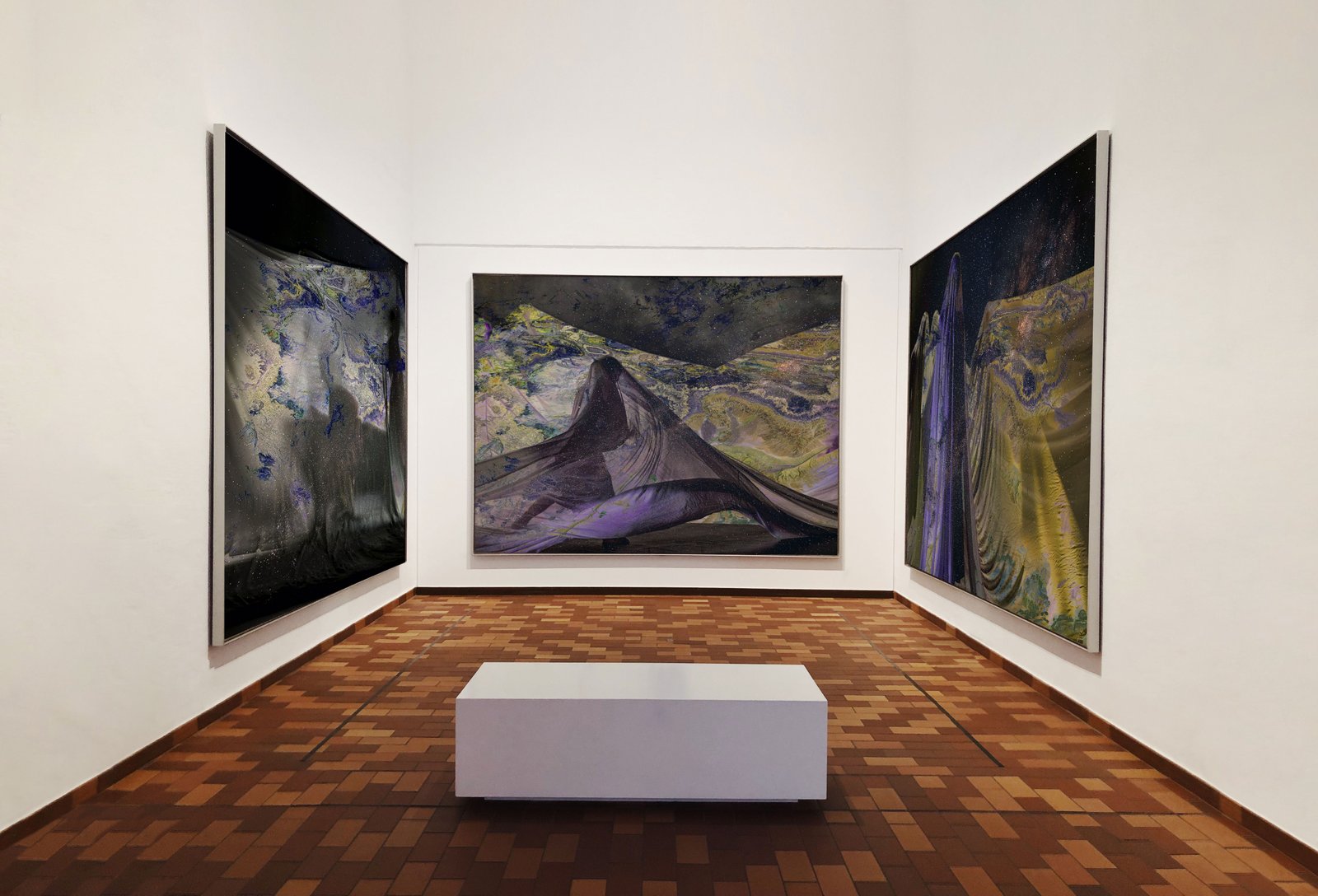
AI art and creativity have become the subject of an unusually persistent argument: can an image generated with artificial intelligence genuinely be considered art?
The question appears simple, but it combines several different issues.
Can an AI system produce something visually original? Does a person who directs a generative model qualify as an artist? Does artistic value depend on manual skill? And does the answer change when an image is selected, edited, combined with other elements or presented within a larger body of work?
These questions are related, but they are not interchangeable.
An image can be visually striking without communicating much. A technically simple work can carry substantial artistic meaning. A carefully directed AI-assisted composition can involve considerable human judgement, while an elaborate automated output may require very little intervention.
The important distinction is not between images made by hand and images made with software.
It is between the many different ways creative work is conceived, developed, interpreted and experienced.
1. Authorship: Who Is Responsible for the Work?
Artistic authorship has never depended exclusively on a single person physically executing every part of a work. Photography, printmaking, filmmaking, conceptual art and collaborative installations have long challenged the assumption that the artist must personally produce every visible element.
Generative AI introduces another layer of complexity. A model’s output depends on its development, training data, architecture, user instructions and generation settings. A person may then select, reject, edit, composite or reinterpret the resulting material. The final work can emerge from several stages of human and computational activity.
This does not mean everyone involved in creating the technology automatically becomes a co-author of every resulting image. Nor does it establish that the person entering a prompt necessarily has legal authorship of the output. Artistic attribution, creative responsibility and copyright protection are distinct questions.
Authorship as a Creative Responsibility
Consider two people using the same image-generation model.
The first enters a short description, accepts the initial output and publishes it without further consideration.
The second develops a visual concept, explores different compositions, rejects unsuitable results, modifies generated elements, combines them with original material and places the finished image within a carefully constructed series.
Both have used AI, but their creative processes differ substantially.
The distinction does not automatically determine which work is better art.
It does demonstrate why evaluating AI-assisted creativity requires examining more than the software used.
2. Prompting, Selection and Editing: Where Does the Craft Begin?
Prompting is often dismissed as an effortless activity. At the opposite extreme, it is sometimes presented as a complete replacement for traditional artistic practice. Neither position adequately describes the range of work involved.
A prompt can be a simple instruction, a detailed visual specification or one component of a larger production process. Its effectiveness depends on the model, the intended result and the user’s ability to recognise and address problems. Some creators use extensive iteration; others work with relatively few generations and substantial editing.
Selection is also a creative decision. Choosing one image rather than another can change a work’s emphasis, ambiguity, emotional effect or narrative. However, selection alone does not guarantee originality or artistic significance. Its importance depends on the context and the nature of the choices being made.
The Creative Process Beyond the Prompt
1)A more complete AI-assisted workflow may involve:
2)Developing a concept or central question.
3)Researching visual and cultural references.
4)Establishing composition, symbolism and visual constraints.
5) Generating and comparing possible directions.
6)Identifying errors, clichés and unwanted associations.
7)Editing or combining generated elements.
8)Refining colour, texture, scale and spatial relationships.
9)Evaluating the work within its intended context.
10) Deciding when the work is complete.
These stages are not compulsory requirements for something to qualify as art.
They demonstrate that generative AI can participate in a creative process rather than constitute the entire process.
The craft lies partly in the decisions made before, during and after generation.
3. Originality: Can Something New Emerge From Learned Patterns?
Generative AI models learn statistical relationships from training data and use those relationships to produce outputs. This raises legitimate questions about imitation, originality and the influence of existing creative work.
However, it would be inaccurate to conclude that model-generated outputs can only reproduce familiar images. Generative systems can produce combinations and arrangements that are novel in meaningful respects. Whether those outputs are artistically original is a different question, involving interpretation, context and judgement.
Human creativity also develops through exposure to existing ideas, techniques and cultural influences. The comparison does not make human and machine processes equivalent, but it challenges the simplistic assumption that originality requires creation without precedent.
Novelty Is Not the Same as Originality
Imagine an AI-generated image of an ordinary chair constructed from impossible geometric surfaces.
The image may be unusual.
But unusual geometry alone does not establish why the work matters.
Now imagine the chair appears in a series examining the disappearance of public gathering spaces. Its materials, proportions and setting are deliberately developed to communicate absence, exclusion or changing social relationships.
The same broad visual subject acquires a different significance through context.
Novelty describes something unfamiliar.
Artistic originality can involve how a work transforms familiar material into a distinctive perspective or experience.
Neither novelty nor originality can be reduced to a simple numerical score.
4. Artistic Intent: Does Meaning Have to Be Planned?
Human intention is important in many artistic practices. Artists make choices about subject, materials, composition, symbolism and presentation. These decisions can shape how a work is understood.
Yet artistic meaning is not determined solely by what the creator intended. Viewers bring their own experiences and interpretations. Accidents, ambiguity and unexpected results can also become important parts of a work.
AI-assisted creation makes this especially visible. A generated image may contain an unexpected relationship between objects, an unusual spatial arrangement or a visual association the creator did not anticipate. The artist may reject it, preserve it or develop it into a new direction.
When an Accident Becomes a Creative Decision
Consider a hypothetical artist exploring the relationship between cities and natural ecosystems.
An image model unexpectedly produces a building whose interior resembles the branching structure of a root system.
The artist did not explicitly request that result.
However, the unexpected form suggests a new visual argument about infrastructure and ecological dependence.
The artist develops the idea through additional images, editing and presentation.
In this example, creative direction emerges through interaction with an unpredictable process.
The value does not depend on every detail being planned in advance.
It depends on how the work develops and what it ultimately communicates or invites viewers to consider.
5. The Value of AI Art: Beyond Speed and Visual Appeal
Generative AI can make certain forms of visual experimentation faster and more accessible. People without extensive experience in traditional image-making may be able to explore compositions, concepts and styles that would otherwise require additional technical skills or resources.
That accessibility is significant, but it does not mean that all creative barriers disappear. Generating a plausible image is different from developing a sustained artistic practice. Visual literacy, conceptual development, editing, research and critical judgement remain relevant.
AI also changes the economics of visual production. Large quantities of imagery can be produced quickly, creating new opportunities for experimentation but also increasing competition, visual saturation and pressure to publish continuously. Greater output does not necessarily produce greater artistic value.
Five Questions for Evaluating AI-Assisted Art
Rather than asking whether an image was generated by AI, consider:
1. What is the work exploring?
Does it present an idea, question, experience or visual investigation worth engaging with?
2. How do its visual choices contribute?
Are composition, colour, form and relationships between elements relevant to the work’s purpose?
3. What decisions shaped the result?
Can the creator explain meaningful choices, revisions or departures from initial outputs?
4. Does the work offer a distinctive experience?
Does it encourage observation, interpretation, curiosity or reconsideration?
5. How does its context affect its meaning?
Would the work be understood differently as a standalone image, part of a series, an installation or an interactive experience?
These questions do not establish a universal definition of art.
They provide a more useful basis for critical discussion than the technology label alone.
Three Creative Approaches Worth Exploring
The Impossible Archive
An artist creates a fictional collection of objects that appear to belong to a civilisation that never existed.
Each object is developed with a consistent visual language, material logic and invented history.
The project examines how museums, photography and archival presentation influence what audiences consider authentic.
AI becomes one method for constructing the visual evidence of an imaginary world.
The Ecological Contradiction
A series depicts familiar consumer objects whose structures gradually transform into ecological systems.
A cabinet contains a branching river network. A mechanical hinge becomes a geological fault. A garment reveals layers resembling a landscape altered by extraction.
The intention is not to create attractive nature-inspired imagery alone.
It is to explore the relationships between consumption, materials and environmental change.
The Unfinished Portrait
An artist develops a sequence of portraits in which selected facial features are replaced by architectural forms, abstract shapes or fragments of landscape.
The transformations are deliberately controlled rather than generated randomly.
The series examines identity, representation and the limits of visual recognition.
In each example, AI assists with image development, but the artistic proposition extends beyond the generation process.
These are illustrative concepts rather than descriptions of existing artworks.
The Ethics of AI-Assisted Artistic Practice
Questions about artistic legitimacy should not obscure the practical responsibilities associated with generative AI.
Training-data provenance, copyright, licensing, privacy, cultural representation and the treatment of creative workers all deserve attention.
Different models and services have different terms, data practices and usage restrictions.
Creators should not assume that an image is free of legal or ethical concerns simply because it was produced through an automated system.
Training Data and Creative Rights
Generative AI has prompted disputes concerning the use of copyrighted works in model training and the legal status of generated outputs.
The relevant rules and outcomes differ across jurisdictions and circumstances.
An artist should therefore distinguish between permission to use a particular AI service, rights in the resulting material and potential claims involving third-party content.
Where commercial use is intended, applicable licence terms and relevant legal requirements should be reviewed.
Cultural Representation
AI-generated imagery can reproduce stereotypes or misrepresent cultural practices.
This becomes particularly important when working with Indigenous knowledge, sacred imagery, community identities or historically sensitive material.
A responsible artistic process may require consultation, permission or collaboration rather than relying on generated approximations.
Environmental Considerations
AI-assisted visual production also uses computing infrastructure and other resources.
Its environmental impact depends on the models, hardware, generation volume, supporting services and broader production workflow.
AI should not automatically be described as either environmentally preferable or environmentally worse than traditional creative production without an appropriate comparison.
For a detailed examination, see The Carbon Cost of Creativity: Comparing AI Art vs. Traditional Visual Production.
A Ten-Step Framework for Developing an AI Art Project
1. Begin with a question. Identify the subject, tension or idea the work will explore.
2. Research the context. Investigate relevant artistic, cultural and conceptual references.
3. Establish visual principles. Define the relationships between form, colour, composition and meaning.
4. Choose suitable tools. Select methods according to the creative requirements rather than novelty.
5. Generate selectively. Explore alternatives without assuming that more outputs automatically improve the work.
6. Evaluate critically. Identify repetition, unintended associations and visual weaknesses.
7. Introduce deliberate interventions. Edit, composite, redraw or otherwise develop the material where appropriate.
8. Consider ethical and legal implications. Review provenance, permissions, representation and intended usage.
9. Test the presentation. Examine how the work functions in its intended format or environment.
10. Reflect on the result. Ask what the finished work communicates and whether its execution supports that purpose.
The framework is intended to support a considered creative process, not impose a fixed definition of artistic legitimacy.
Does AI Change What It Means to Be an Artist?
AI changes some of the skills, tools and production processes available to artists.
It can make certain forms of experimentation easier while introducing new technical, ethical and economic challenges.
But it does not erase traditional artistic practice.
Drawing, painting, sculpture, photography, filmmaking and other disciplines retain their distinct methods and possibilities. Manual execution can itself carry artistic significance, just as conceptual direction or material experimentation can.
AI-assisted creation is another field in which artistic decisions can be made.
Some works may rely heavily on generated material. Others may use AI for a small part of a larger process.
The degree of automation does not, by itself, determine the artistic quality of the result.
Nor should every generated image automatically be treated as a substantial artistic achievement.
Further Reading
Margaret Boden — The Creative Mind: Myths and Mechanisms
A foundational exploration of computational creativity and different forms of creative thinking.
Lev Manovich — AI Aesthetics An examination of artificial intelligence and its relationship to contemporary visual culture.
https://manovich.net/index.php/projects/ai-aesthetics
U.S. Copyright Office — Copyright and Artificial Intelligence Official materials examining copyright questions associated with AI-generated outputs and generative AI development.
UNESCO — Recommendation on the Ethics of Artificial Intelligence An international framework addressing ethical considerations associated with AI, including culture and human rights.
https://www.unesco.org/en/artificial-intelligence/recommendation-ethics
These resources provide different perspectives on creativity, culture and legal rights. They do not establish a single agreed definition of AI art.
Conclusion: The Tool Does Not Set the Standard
The question of whether AI-generated imagery qualifies as art cannot be settled simply by identifying the software used.
Artistic practices have always involved different relationships between intention, execution, materials, chance and interpretation.
Generative AI changes those relationships, sometimes dramatically.
It can expand creative possibilities, accelerate experimentation and introduce new forms of collaboration between people and computational systems.
It can also produce repetitive imagery, encourage superficial production and raise difficult questions about creative rights.
The distinction worth examining is not whether a machine participated in making an image.
It is what the resulting work offers, how it was developed and how it contributes to artistic expression.
AI can generate an image.
Whether that image becomes meaningful art remains a question of creative practice, context and interpretation.