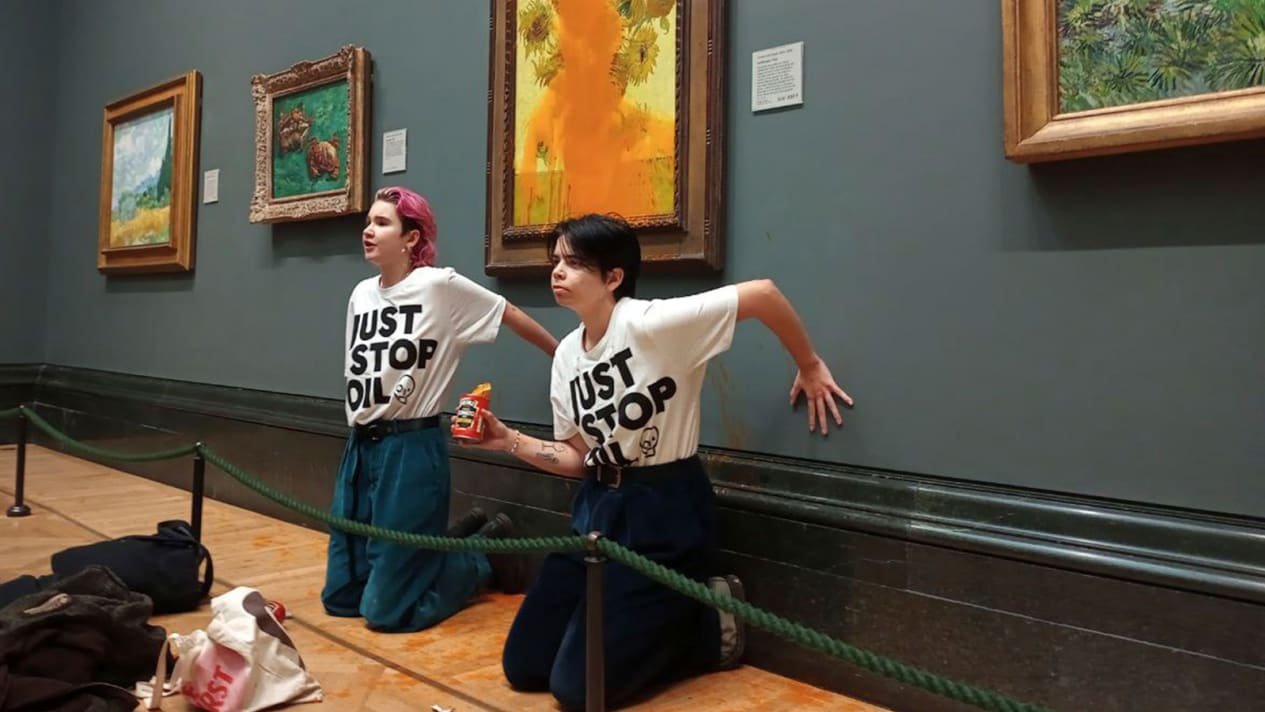
In October 2022, two Just Stop Oil activists threw tomato soup over Vincent van Gogh’s Sunflowers at London’s National Gallery. The painting was protected by glass, although its frame sustained damage. Other demonstrations disrupted roads, sporting events and public spaces, provoking strong reactions from the media and the public.
The protests raised a difficult question: Can a campaign succeed in attracting attention while simultaneously alienating the people it hopes to influence?
Four years later, the question remains relevant to environmental organisations, social movements and brands that publicly support social causes.
Just Stop Oil offers a useful case study in the relationship between visibility, public sentiment, credibility and measurable change. Its experience also challenges the assumption that negative reactions necessarily mean a campaign has failed.
What Happened to Just Stop Oil?
Just Stop Oil emerged in the United Kingdom in February 2022 as a coalition campaigning against new fossil fuel development. Its central demand was for the British government to stop granting new licences and consents for oil and gas projects.
The group became known for nonviolent civil resistance, including road blockades, slow marches, demonstrations at cultural institutions and highly visible symbolic actions.
Its methods were deliberately disruptive. Rather than relying on conventional awareness campaigns, activists sought to interrupt everyday routines and generate widespread public discussion.
The resulting coverage was enormous, but the reaction was divided. Supporters argued that conventional approaches had failed to generate sufficient political urgency around climate change. Critics questioned the disruption to ordinary people, the targeting of cultural institutions and the consequences for public support.
In March 2025, Just Stop Oil announced that it would end its campaign of disruptive street protests. Its final demonstration took place in London on 26 April 2025.
The group described its campaign as successful, pointing to the UK government’s policy against issuing new oil and gas exploration licences. However, that policy outcome cannot be attributed solely to Just Stop Oil. Political developments, other campaigners, electoral decisions and wider climate policy debates also played a role.
The organisation continued supporting activists involved in legal proceedings, illustrating that ending a particular protest strategy does not necessarily mean ending a movement.
Did the Protests Actually Work?
The answer depends on how success is defined.
If the objective was visibility, Just Stop Oil achieved it. Its demonstrations attracted substantial media coverage and brought its name into public discussion.
But visibility is not the same as persuasion, and persuasion is not necessarily the same as policy change.
Research published in Nature Sustainability in 2024 examined public attitudes before and after Just Stop Oil’s disruptive M25 motorway protests in November 2022. The researchers found evidence that the demonstrations increased identification with and support for a more moderate environmental organisation, Friends of the Earth.
This phenomenon is known as the radical flank effect: more confrontational activism can sometimes make moderate organisations appear more acceptable or appealing.
A separate study published in the Journal of Environmental Psychology in 2025 identified a related tension. Extreme protest tactics could reduce support for the activist group itself while increasing concern about climate change and intentions to act.
These findings complicate the familiar argument that disruptive protests simply turn people away from environmental issues.
A campaign can damage perceptions of its organisers while still encouraging wider attention to the underlying cause.
For brands, however, this distinction matters. A social movement may accept reputational costs in pursuit of political change. A business must also consider customer relationships, employees, commercial responsibilities and long-term trust.
The central lesson is that campaign visibility, public approval and meaningful outcomes are three different measures of success.
What Are the Implications for Brands?
Brands increasingly communicate positions on sustainability, inclusion, responsible technology and other societal issues.
Some campaigns attract genuine support. Others generate scepticism, accusations of opportunism or criticism that the company’s public statements do not match its business practices.
The Just Stop Oil case demonstrates why organisations need more than a compelling message. They need a credible purpose, a clear understanding of their audiences and an evidence-based approach to measuring impact.
Here are eight practical lessons.
1. Align Your Social Purpose With Your Core Values
A social cause should have a credible connection to what an organisation does, how it operates and the people it affects.
A fashion business addressing textile waste has an obvious connection to its products and supply chain. A technology company discussing digital accessibility can demonstrate relevance through its design decisions and services.
When the connection is weak, audiences may question whether the organisation is genuinely committed or simply responding to a trending issue.
Before launching a purpose-led initiative, ask:
- What does our organisation stand for?
- How does this issue relate to our products, operations or industry?
- What responsibility or influence do we have?
- What can we realistically change?
- Why should our customers, employees and communities care?
A credible social purpose should be reflected in business decisions, not confined to marketing communications.
2. Define the Issue and Establish Measurable Outcomes
Awareness is useful, but it is not a complete measure of impact. A campaign might generate millions of impressions without changing knowledge, behaviour or organisational practices.
Begin by identifying the specific problem and the outcome you want to achieve.
For example, a company seeking to reduce packaging waste could measure the amount of material eliminated, the percentage of reusable packaging introduced or changes in supplier practices.
An accessibility initiative could track improvements in website usability, product compliance and the experiences of people with disabilities.
Distinguish between three categories:
- Outputs: What the campaign produces, such as events, content, partnerships and audience reach.
- Outcomes: What changes as a result, including knowledge, attitudes, participation or behaviour.
- Impact: The longer-term environmental or social improvements that can be demonstrated.
The distinction prevents a campaign from confusing publicity with progress.
3. Build Partnerships Beyond Your Existing Supporters
Successful social initiatives rarely depend on a single organisation. They benefit from different forms of participation, expertise and influence.
Potential collaborators include:
- Grassroots supporters: Employees, customers, suppliers, local communities and volunteers.
- Subject-matter experts: Researchers, academics, environmental specialists and relevant nonprofit organisations.
- Institutional partners: Industry associations, local authorities and professional bodies.
- Community communicators: Creators, educators and established networks with a genuine interest in the issue.
Each partner should contribute something meaningful, whether expertise, access, practical resources or credibility.
Partnerships also require clear expectations. Organisations should agree on objectives, responsibilities, evidence standards and how outcomes will be reported.
The objective is not to collect endorsements. It is to build the capacity to deliver change.
4. Make Your Message Clear, Human and Relevant
One of the difficulties facing highly visible protest campaigns is that the method can overshadow the message.
People may remember the orange paint, traffic disruption or soup without understanding the policy demand behind the action.
Brands face a similar risk when campaign creativity becomes more memorable than the issue being addressed.
An effective message should answer three questions:
- What is the problem? Explain the issue in terms people can understand.
- Why does it matter? Show its relevance to everyday life, communities or the environment.
- What can be done? Offer a meaningful action, decision or next step.
Avoid inflated claims, vague promises and unnecessary corporate terminology.
A message does not need to be provocative to be effective. It needs to be understandable, credible and worth acting upon.
5. Create Different Ways for People to Participate
Not everyone wants to engage with a cause in the same way.
Some people are prepared to volunteer or attend events. Others prefer to learn, share information, contribute expertise or make small changes in their daily routines.
A strong participation strategy accommodates these differences.
For example, an environmental initiative could offer educational resources, community workshops, employee programmes, volunteering opportunities and practical tools.
Digital channels can extend participation through accessible websites, short videos, newsletters, online discussions and downloadable guides.
However, participation should not become an exercise in collecting clicks. Each activity should have a defined purpose and a reasonable connection to the campaign’s intended outcomes.
Accessibility is equally important. Mobile-friendly content, clear language and multiple communication options help remove unnecessary barriers.
6. Prepare for Criticism Without Dismissing It
Public disagreement is inevitable when organisations engage with complex social or environmental issues.
Criticism may arise from genuine concerns, competing priorities, misunderstanding or opposition to the cause itself.
A brand needs to distinguish between these reactions.
Before launching a campaign, identify likely questions and objections. Consider how the initiative may affect different groups, including those who do not already support the organisation’s position.
Prepare evidence-based responses and establish clear responsibilities for handling public feedback.
Not every negative comment requires a reply. However, substantive concerns about business practices, environmental claims or campaign consequences deserve serious consideration.
Listening is not the same as abandoning a position. It can help organisations improve their approach and demonstrate accountability.
7. Be Transparent About Your Own Practices
An organisation’s credibility depends partly on whether its internal decisions support its external commitments.
A company promoting sustainability should be prepared to discuss its environmental footprint, supply chain practices and areas where progress remains incomplete.
A business advocating workplace inclusion should examine recruitment, representation, accessibility and employee experiences.
Claims should be specific and supported by evidence.
Where data is unavailable or targets have not been achieved, acknowledge the limitations rather than presenting ambition as accomplishment.
Transparency also requires distinguishing between what the organisation directly controls and what depends on partners, suppliers or wider systems.
This reduces the risk of misleading claims and helps audiences make informed judgements.
8. Treat Social Purpose as a Long-Term Commitment
A single campaign cannot establish an organisation’s credibility.
Trust develops through repeated decisions, consistent communication and demonstrable progress.
Purpose-led initiatives therefore need ongoing investment, internal ownership and periodic evaluation.
Organisations should review what worked, what failed and what needs to change.
That may involve adjusting campaign messages, introducing new partnerships, improving business practices or discontinuing activities that do not produce meaningful results.
The willingness to evolve is especially important when new evidence challenges earlier assumptions.
Social purpose becomes more credible when it is treated as part of organisational strategy rather than an occasional promotional theme.
A Practical Framework for Evaluating Purpose-Led Campaigns
Before launching a campaign, assess it against five questions.
| Assessment area | Question to ask |
|---|---|
| Relevance | Is the cause genuinely connected to our organisation and its responsibilities? |
| Credibility | Can we support our claims with evidence and consistent business practices? |
| Participation | Are we giving different audiences meaningful ways to engage? |
| Risk | Have we considered public criticism, unintended consequences and affected communities? |
| Impact | Can we measure outcomes beyond impressions, engagement and publicity? |
This framework helps distinguish campaigns that merely attract attention from initiatives designed to produce lasting value.
Looking Ahead: What Just Stop Oil Teaches Us About Influence
Just Stop Oil’s experience reveals a tension at the heart of public advocacy.
Disruptive communication can command attention without generating affection for the people delivering the message. It can also influence the wider conversation in ways that are not immediately visible through public approval ratings.
The research suggests that reactions to campaign tactics and reactions to the underlying cause should not be treated as identical.
For businesses, the strategic challenge is different from that of a protest movement.
Brands must consider whether their communication builds trust, whether their actions support their claims and whether participation creates genuine value.
Creative campaigns can challenge assumptions and encourage people to reconsider familiar issues. But creativity alone cannot substitute for evidence, accountability or meaningful action.
The lasting lesson is not that brands should avoid controversy or pursue attention at any cost. It is that effective purpose-led communication requires a clear connection between what an organisation says, what it does and what ultimately changes.
References and Further Reading
- Just Stop Oil — Announcement of the End of Disruptive Protests (2025)
- Sky News — Just Stop Oil Holds Final Protest (2025)
- Nature Sustainability — Radical Climate Protests and Support for Moderate Organisations (2024)
- Journal of Environmental Psychology — The Climate Activist’s Dilemma (2025)
- Associated Press — Van Gogh Sunflowers Protests and Legal Consequences (2024)